
The electronic signature market contains a broad variety of solutions from dozens of vendors. Docusign® (a trademark of Docusign, Inc.) is one of the most recognized brands in the space, and organizations often evaluate it alongside other available solutions.
While many eSignature platforms serve similar core functions, there can be meaningful differences from one eSignature solution to the next. Each solution presents distinct features, pricing models, integration capabilities, and support options, which organizations can consider when evaluating their choices. This article is a comparison of electronic signature solutions and is not affiliated with or endorsed by Docusign, Inc., Adobe Inc., Dropbox, Namirial, PandaDoc Inc., Box Inc., Signicat Inc., signNow, Signeasy, or any of their affiliates1.
Finding the perfect eSignature solution
The ideal electronic signature solution for your organization will depend on your unique needs and circumstances. This is especially true for enterprises, as their use cases often involve more sophisticated workflow and support requirements than those of smaller businesses. Features and capabilities vary by provider, plan, and configuration. Organizations should evaluate each solution based on their specific requirements.
For example, an enterprise use case typically involves intricate documents with layers of conditional responses. The automated workflow management functionality required to support such use cases requires enterprise connectors and features that are often unavailable to small business deployments.
eSignature software also needs to keep pace with market changes. As the market evolves, your eSignature provider needs to meet new requirements. Security is a good example. It used to be seen as something only banks and large enterprises needed in an eSignature solution. Today, businesses of every size need to be mindful of various threats like phishing, identity fraud, and ransomware. This makes eSignature security a requirement for all.
To support evaluation efforts for your use cases, we’ve assembled a review of leading vendors. Understanding the strengths and limitations of your options equips you to make an informed decision.
Why consider alternatives to Docusign?
Docusign has earned its place as a market leader by offering an effective solution that is easy to use, reliable, and accessible to small businesses and enterprises alike.
However, the electronic signature market is not a monopoly. Many advanced solutions, like OneSpan Sign, PandaDoc, and Dropbox Sign, offer varying features, pricing models, and capabilities that may align differently with specific use cases and organizational requirements.
When exploring electronic signature solutions, it is important to consider how budget, security, customer service and support, use cases, and industry all impact your evaluation. For enterprise organizations, best practice is to review multiple providers when selecting your electronic signature solution.
To begin, we provide certain features and considerations associated with Docusign.
Docusign
Docusign is a registered trademark of Docusign, Inc.
Core benefits of Docusign
- Market leader: Docusign is the leader in the market with many customers around the globe.
- Full-featured solution: Their solution offers an extensive feature set with hundreds of integrations out of the box.
- Agreement automation platform: To complement their electronic signature solution, Docusign also offers identity verification, remote online notarization, and Contract Lifecycle Management (CLM).
Factors to consider with Docusign
- Pricing: The Docusign pricing model may vary based on plan structure, usage volume, and contract terms. Some customers have publicly discussed higher renewal costs. Organizations evaluating any eSignature solution may wish to review pricing structures carefully to ensure alignment with their expected usage. For additional context, readers may review customer case studies such as this one from an energy retailer.
- Customer support: Docusign offers tiered support plans ranging from basic Support Center access to an enterprise plan with emergency support. For regulated industries, enterprises, and complex use cases, the lower-tier plans may not be sufficient and higher-cost enterprise support may be required.
- Phishing risks in eSignature workflows: Cybersecurity experts have issued warnings about eSignature scams and phishing attempts involving eSignature platforms. Phishers and fraudsters are attracted to well-known brands because of the potential to exploit their large customer base and recognizable name. For instance, phishers can create fraudulent emails with an urgent message designed to prompt the user to click links or open attachments, which can expose users to security risks.
A typical signing process begins with an email invitation to the signing ceremony. Some eSignature platforms offer customers the option to white-label these emails, so the recipient sees the organization’s colors, logo, and email domain. In general, consistent branding and sender recognition can help recipients assess the legitimacy of digital communications. As with many widely used digital services, third-party attackers may attempt to exploit brand familiarity as part of phishing or impersonation campaigns. Organizations can mitigate these risks by reviewing a potential eSignature platform's available branding controls, authentication options, and user-awareness measures when deploying eSignature workflows.
Important details
- Pricing: Docusign offers four different pricing plans. You can review the price per plan below.
- Personal: $10/month
- Standard: $25/month per user
- Business Pro: $40/month per user
- Enhanced plans: Contact Docusign for additional benefits and pricing.
- Publicly listed pricing (subject to change and listed for illustrative purposes only) indicates that Docusign offers multiple plans with monthly pricing that varies by tier and usage. Organizations should review current pricing directly with Docusign to confirm applicability.
- 30-day free trial: Docusign offers a 30-day free trial of their solution. Free trials are good ways to explore and compare different eSignature solutions. (Free trial length may change or vary by region/plan.)
- Support: Docusign offers a variety of support plans with increasing resources and availability of support.

eBook
AI Companion Guide for Evaluating eSignatures
Learn how to use AI effectively in your eSignature evaluation—and strengthen it with the TRUST Framework to make decisions you can defend.
Download now
DOCUSIGN ALTERNATIVES
Explore our market analysis of electronic signature vendors and Docusign alternatives below. We break down leading players in the eSignature space to showcase their strengths and limitations. This analysis will provide essential insight into your options to help you make the best selection for your business.
OneSpan Sign
Docusign alternative for financial services and insurance
OneSpan has more than 25 years of experience in electronic signatures and cybersecurity. The company offers a robust, enterprise-ready digital agreements platform with security at the core. Their eSignature solution, OneSpan Sign, leverages advanced security features such as digital identity verification and authentication options crucial to reducing fraud and supporting the authenticity of each transaction. Similarly, their remote online notarization solution, OneSpan Notary, is designed to help mitigate the risk of fraud associated with traditional notarizations by incorporating features such as strong identity proofing options, built-in security controls (including co-browsing), and robust security measures to secure notarized documents and data-in-transit and at rest. This security and enterprise focus proves to be a key differentiator in highly regulated industries.
OneSpan Sign also integrates with many of the most commonly used enterprise applications, such as Salesforce, SharePoint, and Dynamics, and includes high-value eSignature integrations for enterprise use cases, like workflow customization with Smart Communications and Guidewire.
Top advantages of OneSpan Sign
Trust at the core: OneSpan traces its security roots back over 25 years, and security remains central to everything it does. The company’s eSignature platform is purpose-built for industries where compliance, fraud prevention, and auditability are mission-critical.
OneSpan Sign has been designed to provide best-in-class security features:
- Digital signature technology encrypts each person’s signature
- White-labeling options help reduce the risk of phishing attacks targeting customers
- Wide range of authentication and identity verification methods to choose from, including SMS OTP, government ID verification, biometric verification, Q&A security challenge, knowledge-based authentication (KBA), and passkeys
- Tamper-evident: Documents & signatures are visibly invalidated if changes are detected between signers
- A single, unified audit trail is generated for the transaction, capturing eSignature events in the transaction and, where used, identity verification and authentication
- Audit trail is embedded in the completed signing package for easy verification and storage
- 1-click verification of document validity
Excellent customer service and support: OneSpan’s customer support provides a range of support options designed to meet the enterprise needs of customers. With business-critical support options available 24x7, including human support, developer community, and documentation portal, OneSpan customers get the support they need, when they need it. According to G2 (May 2026 data), OneSpan received a higher rating than Docusign in customer satisfaction with a 93% satisfaction rate for quality of support on G2.com.
“We’re very satisfied with OneSpan support. If we can’t get them on the phone when we call, they call us back quickly.
That’s a big differentiator from Docusign. With Docusign, I had to escalate support requests extremely high. That happened on multiple occasions.”
Energy retailer in North America
Enterprise-ready: OneSpan works with some of the world's most security-conscious organizations. The company recruits experts with the knowledge to provide in-depth consulting and high-standard services. OneSpan is known in the industry as an eSignature provider that understands the needs of regulated enterprise organizations.
OneSpan Sign is designed specifically to meet enterprise needs:
- Globally available solution
- Flexibility to sign via SMS and email notifications
- Integrates with popular business applications
- Complete range of ID-proofing & authentication options, to protect clients and assets while delivering a better user experience
- Flexible workflow and signature capture options for high completion rates
- Scalability to grow with organizational requirements
- A proven migration methodology that simplifies the switch to OneSpan Sign
Ease of use: For both signers and senders, OneSpan Sign ranks highly in usability. According to G2 (2026 data), OneSpan Sign outranks Docusign in ease of use, ease of setup, and ease of administration. Whether you use a desktop, laptop, tablet, or smartphone, OneSpan Sign delivers a seamless experience to securely send and sign documents.
Good partner in doing business: On G2.com, as of May 2026, users rate OneSpan 94% on being a good partner in doing business as compared to Docusign at 83%.
Top limitations of OneSpan Sign
- Brand awareness: Because of OneSpan’s commitment to white labeling, the OneSpan brand is not as well-known. However, OneSpan counts among its client base more than 60% of the world’s 100 largest banks. Chances are you have signed a document with OneSpan Sign without realizing it.
Important details
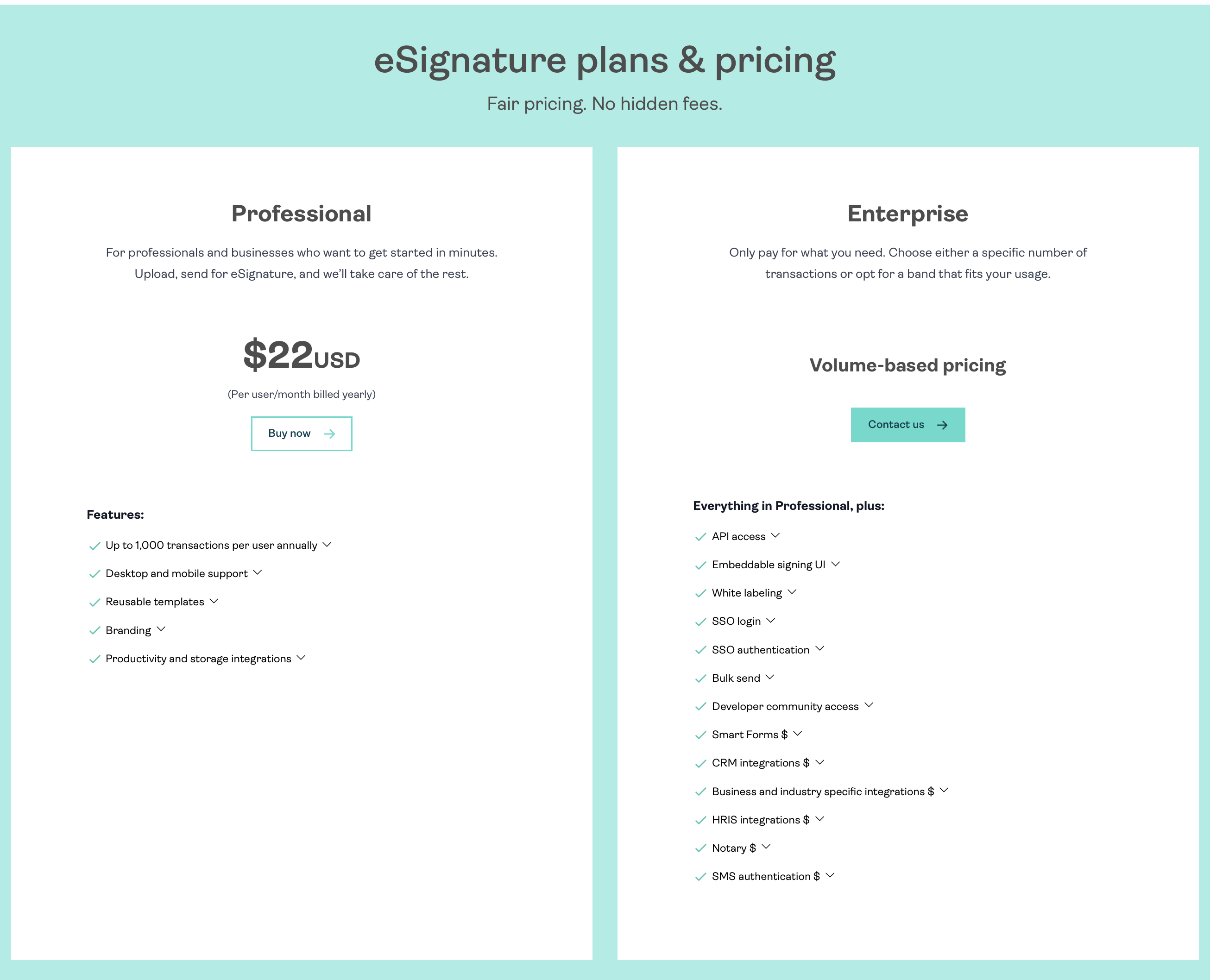
- Pricing: OneSpan offers "fair pricing with no hidden fees." The company has two plans with the ability to further tailor the Enterprise Plan. For Enterprise Plan pricing, choosing between transaction volume and number of users allows enterprises to customize their plan according to their use case. This often leads to a lower total cost than other enterprise plans in the market. Learn more in these case studies with an energy retailer and auto insurer. The company's other plan, the Professional Plan, is designed for businesses of all sizes that want to quickly spin up a deployment of OneSpan Sign and start signing immediately. It can be just as applicable to enterprises for certain use cases.
- Enterprise Plan: OneSpan Sign offers two pricing models. With capacity-based pricing, you pay a fixed price within a defined range or band of transaction volumes. This provides flexibility, especially if you don't know in advance how many transactions you will need. Consumption-based pricing is per-transaction pricing with price breaks applied when predefined thresholds are met.
- Professional Plan: $22/month per user. OneSpan includes 1,000 transactions (envelopes) per year per user as part of the subscription. That’s an average of 4 transactions per business day!
- Publicly listed pricing (subject to change and listed for illustrative purposes only) indicates that OneSpan offers multiple plans with monthly pricing that varies by tier and usage. Organizations should review current pricing directly with OneSpan to confirm applicability.
- 30-day free trial: Interested prospects can enroll in a free 30-day trial of the OneSpan Sign solution. This is an excellent way to compare OneSpan Sign against other eSignature solutions.
- Support: OneSpan offers four different support plan types with options to customize your individual plan. To this point, a OneSpan survey revealed that 91% of OneSpan customers report being satisfied with the service, and OneSpan is consistently ranked higher than Docusign for quality of support on G2.
Learn more about OneSpan Sign in this brief video:
Adobe Acrobat Sign®
Adobe Acrobat Sign is an Adobe Suite solution that offers eSignatures applied to PDF documents in Adobe Acrobat®.
Top advantages of Adobe Acrobat Sign
- Established brand: Adobe is a widely known brand. Adobe has built its brand by offering quality creative and technology solutions that professionals use every day.
- Integrations with major platforms: Acrobat Sign is tightly integrated within the Adobe Experience Cloud and Microsoft ecosystems, supporting document-centric and B2B workflow use cases.
- Adobe Creative Cloud: Adobe Acrobat Sign is one component of Adobe’s larger document and content suite, integrating closely with Acrobat, PDF tools, and Creative Cloud. It enables seamless document workflows within the Adobe ecosystem, particularly for productivity and B2B agreement use cases.
Top limitations of Adobe Acrobat Sign
- Customer service: Adobe's scale as an enterprise may make it challenging to offer personalized support to all of its thousands of customers. Do your due diligence and ask about the size of the team dedicated to customer success and whether phone support is available for the support tier you are considering.
- Pricing: Adobe Acrobat Sign's solution targets large enterprises and is sold at a price point higher than many other competitors in the market. Further, many of its advanced features, including CRM integrations and automated workflows, are only available in the higher-tier plans meant for enterprise customers. Pricing is a common issue cited in reviews of Adobe Acrobat Sign on G2.
- Few integrations: Adobe Acrobat Sign integrates with major platforms, but has fewer integration options than other competitors like OneSpan Sign or Docusign. Notably, Adobe Acrobat Sign is missing some popular connectors, such as Slack and Greenhouse.
Important details
- Adobe Acrobat Sign pricing: Adobe offers various plans to align with deployment needs. However, the plans listed below for individuals and teams are not tailored for enterprise customers. You must speak with the sales team to learn more about their enterprise plan.
- Individual Acrobat Standard. $12.99/month
- Individual Acrobat Pro. $19.99/month
- Team Acrobat Standard. $14.99/month
- Team Acrobat Pro. $23.99/month
- Acrobat Sign Solutions. Contact Adobe for pricing.
- Publicly listed pricing (subject to change and listed for illustrative purposes only) indicates that Adobe offers multiple plans with monthly pricing that varies by tier and usage. Organizations should review current pricing directly with Adobe to confirm applicability.
- 14-day free trial: Try Adobe Acrobat Sign for free for 2 weeks. Begin the trial and compare the Adobe Acrobat Sign experience to other solutions. Many vendors, including OneSpan Sign, also offer a free trial but for a longer period (30 days).
- Support: 24/7 product support is available for enterprise-level customers and it covers Acrobat Pro and Acrobat Sign.
Dropbox Sign
Dropbox, the cloud storage provider, acquired HelloSign in 2019. The acquisition included the HelloSign electronic signature solution; HelloFax, an online fax solution; and HelloWorks, a workflow customization solution. Combined, these solutions add robust document management and signature capabilities to the Dropbox product suite.
Top advantages of Dropbox Sign
- Ease of use: Dropbox Sign's user interface is simple and intuitive. Whether a technical professional or not, users will be able to navigate the applications and eSign documents without difficulty.
- Key integrations out of the box: Pairing electronic signatures with the rest of the Dropbox product suite delivers several key integrations in document storage, including Google Drive and OneDrive, as well as CRM integrations such as Salesforce, Microsoft, and Hubspot.
- Attractive pricing: The price point offered by Dropbox is generally lower than many other competitors. This makes Dropbox Sign an appealing solution to small and medium-sized businesses.
Top limitations of Dropbox Sign
- Few business platform integrations: While Dropbox Sign integrates well with common cloud productivity and CRM platforms, its integration ecosystem is centered on document-centric workflows. Organizations with complex, compliance-driven processes, especially those requiring deep integration into core enterprise systems, secure data flows, and high-assurance transaction orchestration, may find these integrations less suited to regulated-industry requirements without additional custom development.
- Limited enterprise functionality: Dropbox Sign lacks some of the advanced functionality of other leading electronic signature solutions, such as conditional routing and reusable templates. Larger organizations with embedded, high-volume, or compliance-driven processes often require a solution with deeper workflow orchestration, system integration, and governance capabilities.
- Support availability: Support availability may not be as robust as its competitors. Customers can connect with support resources through email, with additional channels available at a premium.
Important details
- Dropbox Sign pricing:
- Essentials (individual plan). $15/month
- Dropbox One with eSign. $25/month
- Premium. Contact Dropbox for more details.
- Publicly listed pricing (subject to change and listed for illustrative purposes only) indicates that DropBox Sign offers multiple plans with monthly pricing that varies by tier and usage. Organizations should review current pricing directly with DropBox Sign to confirm applicability.
- 30-day free trial: Users can enroll in a free 30-day trial of Dropbox Sign.
- Support: Dropbox customers can access support resources through email, and pay for additional support channels.
Namirial
Founded in 2000 in Italy, Namirial delivers software solutions and digital trust services for the digitization of private sector companies and public administration organizations. Namirial’s service and solution offering is aggregated into a platform that includes:
- applications to identify and authenticate users
- workflows to manage signatures and provide certificates for the generation of electronic signatures and electronic seals
- procedures for long-term archiving
- e-invoicing solutions
- certified communications services
Its Namirial Sign component is useful for highly regulated industries in Europe that have heavy requirements for high-assurance use cases.
Top advantages of Namirial
- Regulatory focus: Namirial provides identity management, cybersecurity, and electronic signature capabilities. It focuses on highly regulated industries and use cases.
- Trust provider status: Namirial is an EU-qualified trust service provider (QTSP) and provides qualified signatures, seals, timestamps, and identity certificates, which is of interest to European businesses with a need for qualified electronic signatures (QES).
Top limitations of Namirial
- Regional player: Namirial conducts the vast majority of its business in Europe.
- Usability: According to G2, Namirial is not the most user-friendly solution and scores 23% below the average ease of use score for eSignature vendors.
- Customer support: G2 reviews mention issues with responsiveness and quality of support.
Important details
- Namirial pricing: eSignAnyWhere is free, with a Personal Account costing 9€ per user/month, Professional at 20€ per month, Business at 35€, and an Enterprise account requiring customers to contact sales.
- Publicly listed pricing (subject to change and listed for illustrative purposes only) indicates that Namirial offers multiple plans with monthly pricing that varies by tier and usage. Organizations should review current pricing directly with Namirial to confirm applicability.
PandaDoc
PandaDoc is a document automation and workflow platform that includes eSignature as part of a broader contract and proposal management solution. It is particularly popular among sales organizations looking to streamline proposal creation, approvals, payments, and contract workflows within a single interface.
Top advantages of PandaDoc
- Comprehensive sales document workflows: Beyond electronic signatures, PandaDoc users can generate documents, set up approval workflows, comment on contracts, and more. These efficiency tools, though not involved in the signing ceremony, can help further accelerate workflows that need an electronic signature.
- Template library: PandaDoc supports numerous document formats and integrations as well as a library of over 400 document templates.
- Simple UI for ease of use: PandaDoc has placed a large emphasis on the user experience. The UI is simple and intuitive, contributing to swift adoption and fast onboarding times.
Top limitations of PandaDoc
- Sales-focused architecture: PandaDoc is ideal for the sales use case and its focus on approval workflows and payments reflects that. Enterprises seeking cross-functional deployment across legal, compliance, operations, and regulated business units may require more advanced governance, workflow orchestration, and system integration capabilities. For example, PandaDoc does not offer some of the advanced functions important to legal departments like natural language Q&A, conditional logic, and custom table views. As another example, PandaDoc lacks integrations with HR systems like Workday and Greenhouse. Note that as of May 2026, of the G2 reviews of PandaDoc only 3.5% came from enterprise clients. Compare that to Docusign at 23% and OneSpan at 30%. If your organization is looking for enterprise-grade functionality and support with the requirement to support multiple lines of business, this may not be the right fit.
- Inflexible pricing: Because electronic signature is a component of a larger solution, companies primarily interested in their eSignature tool may find PandaDoc’s pricing high compared to purpose-built electronic signature solutions.
Important details
- PandaDoc pricing: PandaDoc’s Free eSignature plan provides access to payments, a mobile app, and unlimited eSignature use for one user. Paid plans start from $19/user/month.
- Starter: $19/month
- Business: $49/month
- Enterprise: Contact PandaDoc for details
- Publicly listed pricing (subject to change and listed for illustrative purposes only) indicates that PandaDoc offers multiple plans with monthly pricing that varies by tier and usage. Organizations should review current pricing directly with PandaDoc to confirm applicability.
- 14-day free trial: Interested prospects can try PandaDoc for free for 14 days.
- Support: PandaDoc offers 24/7 email and chat support to their customers. Live phone support is available as part of the company's Premium Support package.
Box Sign
Acquired by SignRequest (the Dutch cloud-based e-signature company) in 2021, Box Sign is an eSignature option for businesses that require basic functionality and ease of use, as well as unlimited signatures.
Top advantages of Box Sign
- User interface: Box Sign presents a simple and intuitive user interface for incorporating eSignatures into documents and workflows in Box. It is ideal for customers who are looking for straightforward, standard eSignature functionality.
- Geographic and industry coverage: Existing Box customers use the solution worldwide, as well as across industries, segments, and use cases.
- Pricing: With any Box plan (with the exception of the “Business Starter” plan), you can send unlimited documents for eSignature from the Box web app. eSignature is treated like an added-value feature for all Box customers, and there is total flexibility in terms of document volume—with, however, a cap on API calls.
Top limitations of Box Sign
- Advanced and qualified signatures: Box Sign does not support advanced or qualified signatures, which can be a limitation for enterprises doing business in Europe.
- Limited integrations and out-of-the-box connectors: Salesforce and a handful of other apps are the only out-of-the-box integrations available. This may be an impediment for organizations looking to roll out an eSignature solution across groups and departments.
- Compatibility issue: Box Sign will not work if a “non Box-Verified Enterprise” sends a signature request to an enterprise that has blocked app.box.com.
Important details
- Box Sign pricing: Tiers start at $15/month (Business) and $25 (Business Plus). Enterprise plans start at $35/month, with “Enterprise Plus” pricing starting at $50/month.
- Publicly listed pricing (subject to change and listed for illustrative purposes only) indicates that Box offers multiple plans with monthly pricing that varies by tier and usage. Organizations should review current pricing directly with Box to confirm applicability.
- Free trial: Each of the various tiers offers a 14-day free Box Sign trial. The Box Enterprise trial features unlimited integrations, including DLP and eDiscovery, 2-factor authentication for external users, workflow automation, password policy enforcement, document watermarking, developer sandboxes, and 100,000 API calls per month.
- Support: Technical support is provided during local business hours for Box customers. Tiered support options incorporate features such as prioritized ticket response and 24/7 assistance at the “Enhanced Support” tier.
Signicat
Signicat is a European digital identity company based in Trondheim, Norway. The company was founded in 2007 and offers digital identity and eSignature solutions for the full customer journey, including identity proofing, authentication, trust orchestration, and electronic signature.
Top advantages of Signicat
- Versatile product portfolio: Beyond electronic signature, Signicat offers a suite of complementary products around digital identity, such as solutions with Anti-money Laundering (AML), Know Your Customer (KYC), and Know Your Business (KYB) compliance. They focus on providing secure eSignatures for heavily regulated industries.
- Qualified Trust Service Provider (QTSP) in Europe: Signicat is a qualified TSP that provides stamps, signatures, and seals attesting to the authenticity of the electronic signatures. Access to a TSP to validate qualified electronic signatures (QES) is important to comply with European regulations like eIDAS.
Top limitations of Signicat
- Regional focus: Signicat is based in Norway and mainly focused on the European market.
- Multiple components, one solution: Digital identity, authentication, and eSignature are sold as a packaged solution. Customers interested in a simplified eSignature solution without identity verification may pay for more than they need.
- Limited built-in features: Signicat's electronic signature feature set is not as robust as competitors and does not provide an advanced document creation tool.
- Limited number of connectors and integrations with popular business applications2.
Important details
- Signicat pricing: Pricing plans are not publicly available. Contact Signicat for more details.
- 14-day free trial: For two weeks, users can try Signicat and sample its functionality.
- Support: Support is available to customers through email.
SignNow
SignNow is a California-based electronic signature vendor offering a straightforward alternative to Docusign. Where some competitors offer robust security features or advanced contract management features, SignNow delivers an easy-to-use, easy-to-deploy, stripped-down version of electronic signature software. This makes it an attractive option for small businesses and less complex use cases.
Top advantages of SignNow
- Affordability: SignNow works well for customers who only need to sign documents electronically and is sold at a lower price point.
- Simple UI: The user interface is very intuitive with basic document preparation features including templates, activity notifications, and payment collections.
- Enterprise-level plans available: The enterprise plans deliver important functionality such as approval workflows and some low-level contract management tools.
- Integrations: A large integrations ecosystem available for different business applications.
Top limitations of SignNow
- Weak contract management tools: SignNow delivers electronic signature, but lacks the advanced contract management tools found standard in other solutions.
- Limited functionality in low-tier plans: Customers must purchase the Site License plan to access premium business integrations or use branding features or some compliance features.
- Limited access to data and analytics: Customers are unable to extract and analyze contract data.
Important details
- SignNow pricing:
- Business: $8/month
- Business Premium: $15/month
- Enterprise: $30/month
- Site License: $1.50 per signature invite
- Publicly listed pricing (subject to change and listed for illustrative purposes only) indicates that SignNow offers multiple plans with monthly pricing that varies by tier and usage. Organizations should review current pricing directly with SignNow to confirm applicability.
- Free trial available: Interested parties can try SignNow for free as part of their free trial program.
- Support: Live chat is available with all support plans. Phone support is available on business cloud only.
Signeasy
Signeasy positions itself as the leading eSignature and contract workflow platform, empowering businesses to sign, send, and manage contract workflows. In 2010, the company was founded and launched its mobile-first electronic signature solution; today Signeasy’s offerings include a web app, mobile app, and an API platform3. The Signeasy platform is a strong option for small businesses, especially for users who need to sign contracts quickly and easily from their phones.
Top advantages of Signeasy
- Mobile-native: The Signeasy mobile apps work seamlessly across all iOS and Android devices. They are well-rated on the Apple App Store and Google Play Store. On G2 as of May 21, 2026, Signeasy is rated higher than Docusign for Mobile Signatures.
- Easy to use: True to its name, this company has built its reputation on simplicity and ease of use. May 2026 G2 data shows user reviews rate Signeasy higher than Docusign on ease of use, ease of setup, and ease of admin.
- Customer support: Signeasy offers many support options, which vary by subscription plan. For example, email and chat support is available on the Business plan; however, a dedicated support manager is not available, even on the Business Pro plan. It is only available with custom pricing. Other training and online help options include a knowledge base, tutorial videos, and a support ticket system.
Top limitations of Signeasy
- No support for qualified eSignatures (QES)4: Qualified electronic signatures are a type of eSignature where the signer’s identity has been validated by a Trust Service Provider, in compliance with regulatory requirements such as eIDAS. This may be a limitation for some use cases. We recommend that businesses that require signatures globally and across borders, particularly in Europe, do their due diligence before selecting a vendor that only supports the basic eSignature.
- Limited integrations available: As of May 2026, there are 10 integrations listed on Signeasy’s Integrations page. Notable Signeasy integrations include HubSpot, Microsoft SharePoint, Microsoft Outlook, Microsoft Teams, and Google Workspace. Depending on the use case, enterprise organizations will need to evaluate eSignature vendors that offer integrations with common industry platforms such as Salesforce, nCino, Guidewire, Pega, Smart Communications, Workday, and more.
- Small team: Signeasy is a private company with approximately 80 employees5. This may limit the company’s capacity to provide the required level of implementation services and support, which could be a concern for an enterprise organization.
Important details
- SMB focus: As of May 2026, 69% of Signeasy’s G2 reviews are from small business. While enterprise organizations may be challenged to find the features, expertise, and support they require from a vendor focused on SMB clients, this is an up-and-coming vendor that we expect will grow upmarket in the future.
- Major Player: Signeasy received recognition in 2023 as a Major Player in the 2023 IDC MarketScape Worldwide eSignature Software Vendor Assessment. Leaders in this report include vendors such as Docusign, Adobe, and OneSpan.
- Signeasy pricing: The company offers affordable pricing across these subscription levels:
- Personal: Pricing is $10 per month (1 seat only).
- Business: Pricing is $20 per user, per month.
- Business Pro: $30 per user, per month.
- Build Your Plan: For businesses with custom requirements.
- Publicly listed pricing (subject to change and listed for illustrative purposes only) indicates that Signeasy offers multiple plans with monthly pricing that varies by tier and usage. Organizations should review current pricing directly with Signeasy to confirm applicability.
- Free trial: Signeasy offers a 14-day free trial.
Evaluating eSignature alternatives
When reviewing technology solutions, it is important to know what you are looking for. Perhaps your use case does not require many integrations, or perhaps customer support matters more to you than the price point. Understanding your priorities is key to your evaluation.
Here are a few areas to start when choosing an eSignature solution. Intended use, security, pricing, and support are often the deciding factors when comparing solutions.
Intended use
Depending on what is being signed and who is doing the signing, very different workflows with very different requirements and individuals may be necessary. For example, signing a life insurance policy will be a very different process from signing a school permission slip. Many industries such as insurance, financial services, government, and healthcare, have numerous regulations that must be met for the signature to be valid.
Choose a vendor with experience in your industry and your use case. This is especially important if compliance is a factor.
Ask yourself:
- Who will be signing documents in this workflow?
- What kind of document is being signed?
- Are there compliance considerations for this workflow, such as identity proofing and data privacy?
Security
Security must be central to any technology solution, and electronic signature security and trust is no different. An insecure electronic signature solution could leave your signers vulnerable to phishing, account takeover, or identity fraud. This becomes all the more important as the value of the transaction or workflow increases. Poor security could also lower completion rates as prospects abandon the workflow or worse, can lead to significant fraud losses. Signers who open new bank accounts, for example, could impersonate compromised identities with forged or stolen documents.
Ask yourself:
- Does the solution support two-factor authentication (2FA) or multi-factor authentication (MFA)?
- What identity verification and authentication methods are available?
- Is the document tamper-sealed after each signature?
- Can the eSigned document and its audit trail be archived in my own systems, independently of the eSignature service?
- Does the solution offer local data hosting backed by bank-grade security?
Plans & pricing
If you are wondering how to evaluate eSignature pricing, you are not alone. Pricing plans across vendors are usually organized in a couple of ways: by individual or business plans, and by small and large businesses. In addition, many vendors offer either a free trial, freemium plan, or both. These are best used to explore the solution and tend to have limited features. Understanding which plan supports your use case will help you avoid selecting an inadequate plan.
Enterprises need a pricing plan at a scale that matches their usage. Otherwise, they risk overpaying per user or signature compared to other plans. For example, OneSpan Sign’s enterprise pricing plan focuses on flexibility and predictability. Customers can choose between capacity-based pricing (band) and consumption-based pricing (per transaction). This flexibility allows organizations to move up and down tiers without worrying about overcommitting to transaction volume, being penalized for overconsuming, or counting the number of users.
Ask yourself:
- How volume of signature transactions will I have this year?
- Does the vendor provide the flexibility to scale up or down easily?
- What is the best pricing model for my use case?
Customer support
Customer support varies widely from one vendor to the next. Some offer little more than self-service options while others have full 24-hour response teams with tight service-level agreements (SLAs). From a customer perspective, it is about balancing price with necessary support resources for your workflow.
However, for enterprise customers, support plans should be one of the top criteria in the evaluation. Enterprise workflows operate at a scale and value beyond small organizations, so downtime in these processes has greater consequences – particularly when capturing eSignatures from customers.
Ask yourself:
- What support resources do I need for continued success?
- Are self-service resources sufficient?
- What kind of response time do I need when issues arise?
White-labeling
White-labeling is when a product is sold without the branding of the manufacturer or developer. Instead, the customer can rebrand the product with their own branding, so that it appears like a solution developed by the organization. In the context of electronic signatures, this is an important consideration for several reasons.
First, it creates a seamless experience for the signer from beginning to end. From the first invitation email through the signing process, the signer engages only with your brand. This builds trust in the process and leads to higher completion rates.
Second, it can be important in preventing phishing attempts. As scammers target eSignature signers with phishing emails, your signing workflow will be harder to replicate, and your customers will be more likely to identify the fraud before clicking.
Ask yourself:
- Does the solution enable me to white-label the experience?
- What is the difference between the “custom branding” the vendor offers, and a fully white-labeled experience?
- How will the branding affect my signers’ trust in the process?
Integration capabilities
Electronic signatures rarely operate in isolation. Integrations with key applications like Salesforce, SharePoint, Google Drive, and Box can ensure your workflow aligns with other lines of business and your data remains clean and consistent across applications. These applications are nearly ubiquitous at the enterprise level, so alignment across them can create significant efficiencies.
Further, electronic signature processes often start in one line of business and expand to others. Selecting a vendor with the right integrations helps the solution grow with the organization.
Ask yourself:
- What applications are important to the workflow? Are there integrations?
- What other lines of business might benefit from eSignatures in the future?
- If required, does the vendor integrate with Trust Service Providers (TSP) to support qualified electronic signatures?
- Does the vendor offer authentication options within third-party app integrations?
Ease of use
At the enterprise level, the customer experience is of the highest priority. Internal admins need visibility and analytics into the application’s use, and signers need to be able to join a signing ceremony, review the contract, and apply their signature in a completely intuitive experience. There is no time or appetite for training or tutorials.
The various free plans and free trials are valuable for determining the solution's ease of use. Try out the application and imagine yourself as the signer.
Ask yourself:
- Is the solution frustrating to use on a first attempt?
- Will your signers be able to navigate the process unassisted?
- How many steps are required to complete the workflow? Does it vary by vendor?
- Can you tailor the workflow and choose options such as the type of authentication to create the right experience for your customers, in their preferred channel?
- Does the service support accessibility features?
Global offering
Enterprise organizations commonly operate across geographies and languages. For that reason, you should review an electronic signature vendor’s global footprint. You may want to determine whether the solution can be used in other languages and whether support resources are offered in these languages.
Ask yourself:
- Does this vendor serve a global market?
- Does this vendor have experience digitizing business processes for compliance in various regions?
- Does the vendor have key certifications, such as FedRAMP, HIPAA, SOC2 & 3? Is it compliant with GDPR, eIDAS, and others?
Learn more about OneSpan Sign
In today's digital age, businesses seek eSignature solutions that enhance efficiency and security. OneSpan is a reliable choice, offering advanced technology, robust security features, and top-of-the-line customer service to round out an excellent experience.
Discover how OneSpan Sign can elevate your organization's digital signing process. Learn about our strengths and limitations compared to other eSignature providers and make an informed choice for your electronic signature needs. Sign up for a free trial today.

Free trial
Try OneSpan Sign for free for 30 days
See how easy it is to securely create, send, and sign digital agreements.
Try now
The information contained on this page is for information purposes only, provided as is as of the date of publication. OneSpan does not accept liability for the contents of these materials or for third parties. All trademarks are the property of their respective owners. Last updated May 29, 2026.
1 DocuSign, Adobe, Acrobat, Adobe Acrobat Sign, Dropbox Sign, Namirial, PandaDoc, Box Sign, Signicat, signNow, and Signeasy, are trademarks or registered trademarks of their respective owners. All other trademarks are the property of their respective owners.
2 https://www.signicat.com/plugins
3 https://signeasy.com/blog/company/idc-marketscape/
4 IDC MarketScape Worldwide eSignature Software 2023 Vendor Assessment, https://www.idc.com/research/viewtoc.jsp?containerId=US49646923
5 Signeasy: A Founder’s Journey from Aha Moment to 7-Figure SaaS / Competing with Docusign by being 10x easier to use – with Sunil Patro [351] | SaaS Club